Bypass, Arena Podhale, acoustic screens - these are the most important questions that the PO MP had to answer
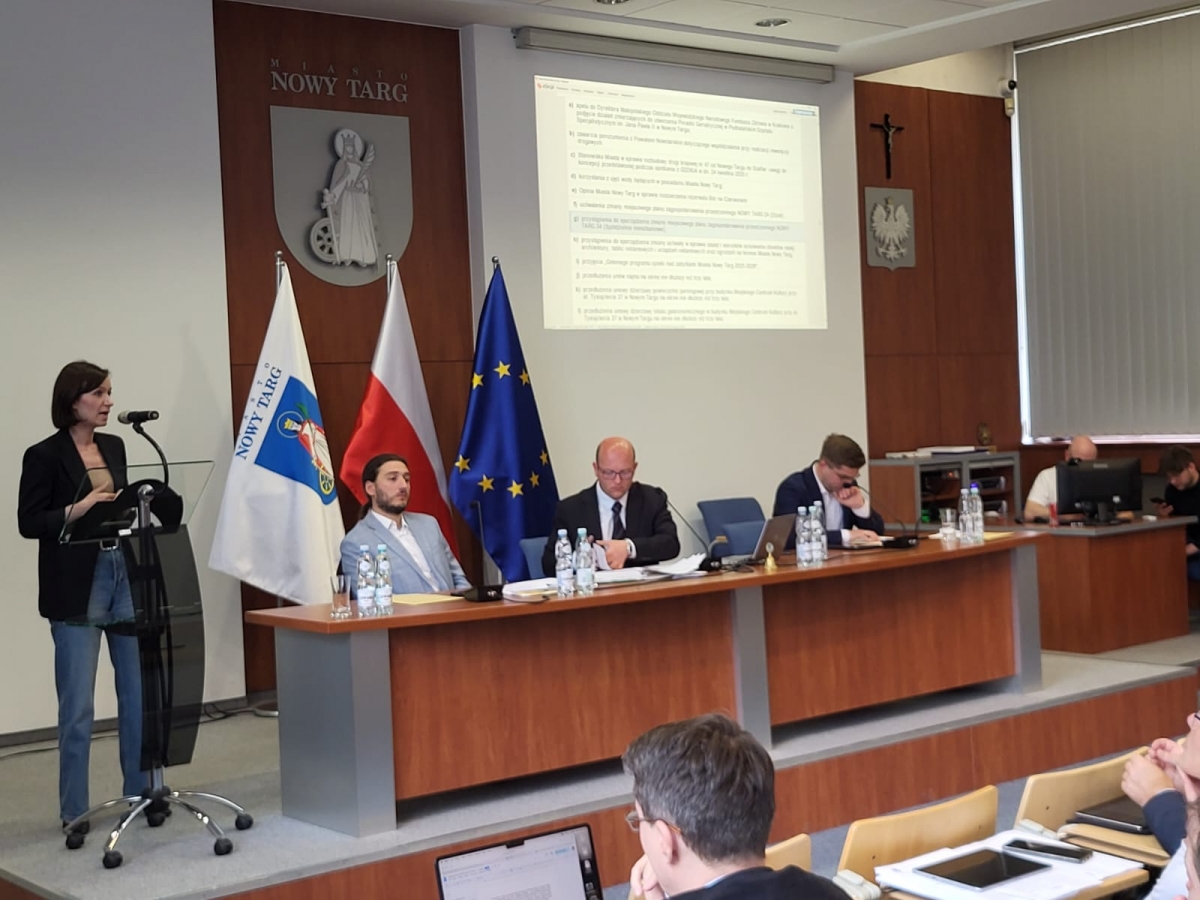
Weronika Smarduch, a Civic Platform MP, appeared at today's session of Nowy Targ City Council. She began by emphasizing her interest in Nowy Targ's local issues. Although, as she noted, there are many issues "beyond the city limits," she herself is open to various forms of dialogue.
"I would like to hear your voice," she addressed the councilors. And she did.
The most time-consuming aspect was the issue of the city's southern bypass. After protests from some residents, the concept was submitted for further consultation, and the General Directorate for National Roads and Motorways (GDDKiA) prepared another version of the proposed route, including the so-called social option, which, as it turns out, has little in common with the social proposals.
The social option is anti-social. Will there be a compromise option?
"The social option must be thoroughly analyzed and presented during consultations with residents. Another compromise option is being prepared. We have to wait until they present it. What has changed at GDDKiA is its openness to dialogue." We're in a comfortable situation – most bypasses don't have a court ruling requiring the development of a social option. Investments must move forward, but they should make a decision that will provide a long-term solution," emphasizes the Civic Platform (PO) MP.
A Phoenix and a Slap in the Face for Everyone
Councilor Maciej Tokarz raised this issue, arguing that the option presented by the General Directorate for National Roads and Motorways (GDDKiA) as a social option is unacceptable. It cuts through a forest and Natura 2000 areas.
"It's designed to be rejected out of hand. It also doesn't solve the traffic problem, as it won't serve the Nowy Targ-Krościenko route, which accounts for a third of that traffic. It's a slap in the face to the residents, the association, and everyone who participated in the process of preparing this social objection. We don't expect much, just that our route be analyzed. If the analysis shows it's bad, we'll accept it," Tokarz explained, requesting intervention.
He noted that the bypass construction program implemented by the PiS government is financed with European funds from the Feniks program, which was not intended for road reconstruction. The condition for the exemption in Poland was that it would not be about roads but rather about the environment – moving them outside the cities to improve the lives of residents.
"And these proposals are counterproductive; they introduce traffic into the city, and through the most populated areas. In this way, the investor is deceiving the European Commission. This could result in the investment being postponed for years and losing funding if these concerns are raised with the European Commission," Councilor Tokarz concluded.
We've hit a wall.
The MP argued that she would propose to the director of the General Directorate for National Roads and Motorways (GDDKiA) to come and talk to stakeholders in Nowy Targ.
"We will keep an eye on this issue; it's not a simple matter. We all know that this bypass is very necessary and important, and a social option should be agreed upon as soon as possible and be acceptable to all parties." If this extends the matter by six months and allows for decades to resolve the problem, then it's worth doing," emphasized Weronika Smarduch.
Councilor Szymon Fatla noted that those who led to the construction of the southern junction of the Zakopianka road without agreeing on the further route should be held accountable.
"This 'compromise,' presented by the General Directorate for National Roads and Motorways (GDDKiA) as an anti-social option, has little to do with compromise. It would be a shame for this road to be blocked due to bureaucratic errors. We just need to sit down, talk, and listen. And during the talks at the district office, which I attended, there was a wall," admitted Jan Sięka.
A Bucket of Cold Water?
Councilor Marcin Jagła submitted another motion to MP Weronika Smarduch, referring to her statement regarding the construction of a new ice arena in the city.
She spoke about the strategic investment program in sports implemented by the ministry.
"Discussion about hockey and its future is very important. It's our tradition." I'd be in favor of considering how to revive this sport, because it's our tradition, like highland culture. There are support programs, and we'll be able to obtain funding. We're finalizing the KPO application process and need to spend it quickly," she noted.
However, the councilor concluded from her statement that this isn't a simple matter, and the parliamentarian herself isn't enthusiastic about the idea.
"I'd like to say that a bucket of cold water has been poured over our local governments. The mayor said the Ministry of Sport has given the green light for this investment. I'd like to ask for specifics on when the strategic investment program for sports will be launched, what funds can be expected, and what percentage of subsidies local governments can count on?" the councilor asked.
Weronika Smarduch explained that this construction is a strategic investment for sports, hence the "green light" for it. However, without submitting an application, it's difficult to discuss possible funding.
"This isn't a cheap investment, and the grant won't cover the entire cost. But we can explore other options or even implement it in stages. Submitting an application is crucial to be able to discuss specific issues. The level of funding depends on the costs and the ability to negotiate with the local government," she noted.
She emphasized that information about the application deadline should be available by the end of June, and then the application will need to be submitted. Submitting an application does not obligate us to sign a contract.
"It's important to implement such long-term investments through compromise. This can't be achieved solely by the mayor or the city council. There must be a compromise so that all parties are certain about this investment," she emphasized.
Snow Law in the Waiting Room
Marcin Jagła also asked about the so-called snow law, which was discussed during Donald Tusk's previous administration.
"There was a draft amendment to the Civil Code allowing for changes to be implemented regarding such investments despite the opposition of some landowners. Discussions regarding the Dziubasówki estate in Nowy Targ have been ongoing for years. Are there any ongoing talks regarding the implementation of this law?" Jagła asked.
The MP argued that the problem is recurring; the next parliamentary committee on tourism development in mountainous areas will be devoted to this very issue.
"This is a serious challenge, especially since many ski resorts had long-term lease agreements, and many of them are already expiring. This is a serious challenge if we want to invest in this type of tourism. The development of skiing is important, but on the other hand, other challenges arise, such as global warming and the rising costs of this activity," she noted.
Refugees? Not the Place
Tadeusz Morawa, a PiS councilor, rushed to ask his usual question about immigrants and the construction of integration centers, but was interrupted by Chairman Jan Sięka.
"This is not a question about local politics, but about local issues. Please refrain from using tactics that could create the impression of a political campaign in one direction or the other." We're talking about local investments, Podhale. I don't want it to interfere with our city affairs," Sięka said.
Scandal, or what's all the noise about?
Ewa Pawlikowska raised another sensitive local issue. It concerns the noise barriers that are missing on the newly constructed sections of the Zakopianka road.
"There are three places where, in my opinion, it's scandalous that the barriers weren't designed from the very beginning. Most shamefully, the contract stipulates that the barriers can only be installed 12 months after the road's opening. The General Directorate for National Roads and Motorways (GDDKiA) itself was unable to do this because it runs the risk of incurring costs for an order outside the contract. We will remind them about the need for tests, and I will ask when they will conduct them. They are supposed to last 30 days, and I will supervise them," declared Weronika Smarduch.
Józef Figura
Source: Podhale24.pl